

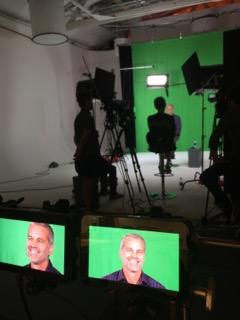
Author James Hankins being interviewed in September 2015 about his thriller story The Prettiest One for Kindle Most Wanted, Amazon’s community for fans, mysteries and suspense novels. (Photo permission and courtesy of James Hankins.)
This blog post is the second of a two–part interview with author James Hankins. Following the format I used last week in writing about James and his storytelling, I am just going to go right back into the interview with him without any further comment.
(Photo permission and courtesy of James Hankins.)
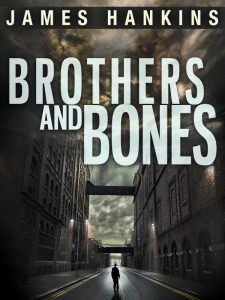
Brothers and Bones
Kindle Edition, 365 pages
Published October 24, 2012 by Amazon Digital Services
Sold by: Amazon Digital Services LLC A legal thriller.
” . . . I wrote Brothers and Bones, and though I’m not rating or reviewing the book, I thought I’d write about what made me come up with the idea for the story. It was a single moment several years ago. I was working as a lawyer in Boston and every day after work, as I walked to the subway station, I would pass the same man. He was likely homeless. He dressed in rags. Long hair, long beard. He never asked for money. Most strikingly, he was usually talking to himself — or seemingly to a mailbox or a parking meter. Sometimes these dialogues were heated. One day, I imagined walking past him and having suddenly look up and say, very clearly and lucidly, “Hi, James,” before returning to his animated self-dialogue. I found the thought to be creepy and I wondered what could be behind such a moment. And Brothers and Bones was born.” — James Hankins
Why do you think modern, sophisticated people in the 21st century are so attracted to the genres in which you are writing?
For the same reason I read the books others write in my genre: escapism. I think the same can be said for people reading romance or fantasy. We all like to be transported to another place, to get the chance to be another person for a little while. Reading stories like these allows us to be in places we have never been or ever will be, and to do things we would never do. And, sometimes, they give us the chance to piece together an intriguing puzzle, or simply to sit breathless on the edges of our seats as we read what they have written.
Which period of time and what place do you find yourself writing about most often?
I mostly write about the present day. A lot of my stories take place in Massachusetts. Shady Cross, though, is straight out of my imagination. I made up the city in Indiana where it takes place. But I tend to write about places I am familiar with. Brothers and Bones is a good example. It starts with a homeless man [Bonz] in a subway in Boston. Charlie [Assistant U.S. Attorney Charlie Beckham, who is the protagonist in the story] drops his coin in the man’s begging cup and then hears the homeless man call him by a secret nickname, one known only to his brother Jake, who has been missing for thirteen years. For months, I would pass a man very much like Bonz every day on the way to the subway. One day, I imagined, as I passed, him interrupting the conversation he was having with himself and saying hello to me by name. It was a strange notion but it came from an actual person in Boston. So the entire story takes place in and around there.
(Photo permission and courtesy of James Hankins.)
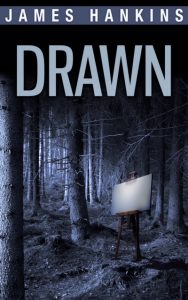
ebook, 342 pages
Published October 25, 2012 by Smashwords
Sold by: Amazon Digital Services LLC
A paranormal thriller.
* Reached #31 in the Kindle Top 100
* Reached #1 in Ghost Fiction
” . . . I wrote Drawn and thought it might be interesting to talk about how I came up with the premise for it. The first kernel of an idea came when I was looking at old family photographs in an album. It was a picture from one of our family vacations. We were at an amusement park. I was probably 8 years old. Though I’d seen the picture many times before, I noticed for the first time a man in the background, seemingly looking at our camera — someone not with us — and I imagined how chilling it would be if I saw the same man in a picture in the background of a different picture, from a different vacation the following summer, and again, he was staring right at the camera. And what if I turned a few more pages and saw that same guy, again staring right at me, from another place and time. What if this same guy was there all that time, in the backgrounds of all those photos and more, looking right at the camera, and we never noticed him?
Thinking about a possible story for me, I changed photographs to paintings, then I changed the man to a boy because, well, kids can be creepy. Remember “Children of the Corn?” Anyway, I added other characters and a lot more story, but that’s how Drawn began.” — James Hankins
When you hear from your readers, what do they say about your novels and/or your writing?
People are very kind when they write to me. Many say that they love my books and have told their friends and family to read them. My primary marketing tool is word of mouth, as well as the vitally important reader reviews on Amazon and Goodreads; so, when people say nice things about my work, I appreciate it enormously.
What do you consider to be your best accomplishment in life?
My children. If I had never “made it” professionally, as long as I help raise good, happy human beings, then I will have succeeded in life.
In your writing?
Connecting with people; it has allowed me to interact with so many people and to be part of a community whom I admire.
Is there a central message in your novels that you hope readers will grasp?
I never actively try to send messages with my work, but themes run through many of my books: the importance of the people in your life, and the importance of family in particular.
I explore the other side of those themes in Shady Cross. In his hour of need, Stokes, my protagonist, keeps running up against people whom he hasn’t treated well over his life, and he has to reap what he has sown. If he had only treated those around him differently, perhaps he would find a helping hand when he needs it most.
In an interview with Ognian Georgiev, James was asked the following question, which is very similar to the one I asked him above:
“Drawn, Jack of Spades, and Shady Cross became Amazon bestsellers. If you compare each of the novels to a feeling what will it be?”
“Interesting question. Never heard one like it before. Hmmm. I suppose, for example, Drawn would be the feeling of not wanting to be lonely any longer. Jack of Spades could be fear. And Shady Cross might be the feeling of knowing you need to do the right thing no matter how painful that might be.”
(Photo permission and courtesy of James Hankins.)
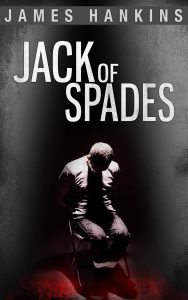
Kindle Edition, 296 pages
Published October 25, 2012 by Amazon Digital Services
Sold by: Amazon Digital Services LLC
A cop police procedural and suspense crime psycho-thriller.
” . . . I thought readers might be interested to know how I came up with the idea for the book. It came to me in the middle of the night, when I woke up from a deep sleep. Lying in the dark, this bizarre thought came to me: “What if when I open my eyes, someone is standing beside my bed with a knife? Someone famous. No, not merely famous but, in fact, someone loved my millions.” The idea of such a strange, creepy occurrence kept me up all night — not in fear of famous boogeymen appearing in my room, but with interest in the possibilities of a story there for me. Soon I was writing Jack of Spades.” — James Hankins
How much research do you do for your stories?
A lot more than I need to. Maybe only 10 percent of it gets into a book, but in the beginning you have to cast a wide net. You don’t know what you need until you get a sense of the playing field; then you can do some fine tuning with respect to research.
For instance, I’m writing a book right now in which one of the characters is in a coma. However, I decided that, for purposes of the story, he should instead be in a persistent vegetative state, which is similar but different in many ways. It might seem like a small change on its surface, but I spent hours researching the differences and revising all the places in the book where those differences impacted the story. So long after I thought I was finished with the research for this book, I spent much of an entire day back at it.
When do you know that you have completed telling your story?
There’s not necessarily a precise moment when I know that it’s completely finished, like snapping a final piece into a puzzle. Rather, it’s something I feel. If I’ve included all of my plot points, added enough twists to keep things interesting, developed the characters as fully as I think the story requires, and I’ve tightened the text as much as I can without losing something I think I need…I’m probably finished. At some point, tinkering isn’t necessarily improving the book, but merely changing it. So you try to find a feel for the point at which edits are merely taking you sideways rather than forward. If you’re there, you’re probably finished.
How do you think you’ve evolved creatively?
I hope I’ve gotten better. I like to think I’m more able to streamline; to make the story tighter, more concise, and to craft a match between what readers are looking for and the story I want to tell.
Any tips on how to get through the dreaded writer’s block?
. . . With a bulldozer, or maybe a tank. Keep writing, even though what you may be writing is not golden at the moment. If I’m just sitting, I’m not writing. Get the creative juices flowing again. Take a long walk. Take a drive. The stuff will percolate: just keep at it.
When you are interviewed, what question do you most look forward to answering?
Probably what I find most fulfilling. I like the opportunity to say how thankful I am: for my wife, who has encouraged me all along, and for my agent who stuck with me for many years before I earned him a dime, and, of course, to readers who read my books and are kind enough to ask for more. I am very thankful to be able to do what I am doing, and I couldn’t do it without the support of my readers and those around me.
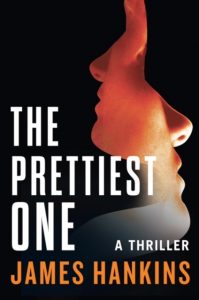
(Photo permission and courtesy of James Hankins.)
Kindle Edition, 402 pages
Published October 1, 2015 by Thomas & Mercer
Crime thriller / psychological suspense
“How did you decide to write the story?” — Ognian Georgiev
– “I was doing general psychological research and stumbled on an article about a rare but—to me, at least—fascinating form of amnesia called a dissociative fugue (the name changes now and then in the various editions of the DSM). A dissociative fugue is a very specific kind of amnesia in which a person loses memory of herself and will actually travel to a different place and often create an entirely new identity there. And when her memories of her former life return (after hours, days, months, or even years), she typically remembers none of the time spent in the fugue state. She remembers her former life but totally forgets the newer one. To me, the story possibilities seemed nearly endless.” — James Hankins
What is it about writing that gives you strength, perhaps a verification of joy in what you are doing?
I’ve always wanted to tell stories. For a long time, I wrote them without knowing whether they would ever be heard by anyone outside of my immediate family. Now, there are people I’ve never met reading my books. There’s a lot of joy for me in that.
Any advice or thoughts for new writers that you wish to share?
I think new writers should strongly consider hiring a professional editor before submitting their work. The level of editing they receive will depend in part on how much they are willing to spend and what they ask the editors to do, but good editors see things that we authors might miss. Also, if a new writer is thinking of self-publishing, hiring a graphic designer to do their covers—one with experience designing ebook covers, in particular—would be money well spent. Above all, of course, I advise writers to write as much as possible, and read as much as they can.
Reflection:
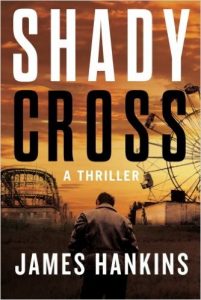
(Photo permission and courtesy of James Hankins.)
Kindle Edition, 334 pages
Published February 24th 2015 by Thomas & Mercer
Top 50 Books of 2015 Best Ex-Con Kidnapper in a Mystery Crime Thriller.
It was an absolute delight to talk with James. His responses revealed to me just how much he is dedicated to his writing.
Yet, what is fascinating to me is how important it is that a writer has support from those closest to him or her.
Stephen King is surrounded by a truly loving family, Tabitha and Joe Hill are writers in their own regard, too, thus giving Steve a deeper context and writing environment in which to write.
“Storyman” David Estes frankly admits how much his wife Adele has helped and supported him in his writing.
James Hankins has the blessings also of a wife who has encouraged him and understood the passion he has for his art. Colleen’s support is invaluable in helping him give his full concentration to his literary journey.
In my own instance, I could not be doing what I am doing creatively without the complete, enthusiastic support of Carolyn. I would have never even ventured into writing The Immortality Wars series without her love and appreciation for what I am doing.
Writing, as it is often characterized, is a lonely profession. The prolific writer and scholar Issac Asimov† (1920–1992) expressed this sentiment similarly by saying, “Writing is a lonely job. Even if a writer socializes regularly, when he gets down to the real business of his life, it is he and his typewriter or word processor. No one else is or can be involved in the matter.”
I venture to say that while storytellers are solely in the process and struggle of creating stories, their solitary venturing can be made less lonely by those around them. This backing is vitally important because this support lends strength to the power and expression of these artists’ creativity. The effect of such backing and advocacy provides invaluable reinforcement to writers. This endorsement and patronage of the heart provides writers with wings to do their storytelling . . .
Related Links:
Storyteller James Hankins:
https://www.goodreads.com/author/show/6644088.James_Hankins
https://www.facebook.com/JamesHankinsAuthorPage
https://www.goodreads.com/author/show/6644088.James_Hankins
https://twitter.com/james_hankins_
http://patch.com/massachusetts/swampscott/james-hankin-local-author-with-three-amazon-best-sellers
†Storyteller Issac Asimov:
http://www.asimovonline.com/asimov_home_page.html
https://www.goodreads.com/author/show/16667.Isaac_Asimov
http://www.huffingtonpost.com/2014/01/02/isaac-asimov-2014_n_4530785.html
https://en.wikipedia.org/wiki/Isaac_Asimov
If you enjoyed reading this post, please share it with others.
Disclosure of Material Connection: I have not received any compensation for writing this post. I have no material connection to the brands, products or services that I have mentioned here. I am disclosing this information in accordance with the Federal Trade Commission’s 16 CFR, Part 255: “Guides Concerning the Use of Endorsements and Testimonials in Advertising.”
© 16 June 2016 by A. Keith Carreiro
2 comments. Leave new
Amazing Blog for Author James Hankins! You captured that!! Awesome! All readers out there, look for the in the very near future, the first novella of “THE PENITINT” PART ONE, of a Triolgy, “Immortity Wars” It will be amazing!
Thank you, Carolyn. Your support for my writing is deeply appreciated.